
SIGMA
Smart Integrated Guardian for Monitoring and Assistance — an IoT smart cane for fall detection and real-time location monitoring.
Project Overview
SIGMA (Smart Integrated Guardian for Monitoring and Assistance) is an IoT smart cane developed as a Project-Based Learning (PBL) project in the Applied Software Engineering (TRPL) study program at Politeknik Negeri Batam. The device is designed for visually impaired people who often move around without a companion.
A conventional white cane helps its user avoid obstacles directly in front of them, but it cannot tell a family member when the user has fallen or where the user is. SIGMA closes that gap by combining fall detection, obstacle detection, real-time location tracking, and a panic button in a single smart cane, connected to a mobile app for the guardian.
The project aims to help users move more safely and independently, while giving families and caregivers the information they need to respond quickly when something goes wrong.
Key Features
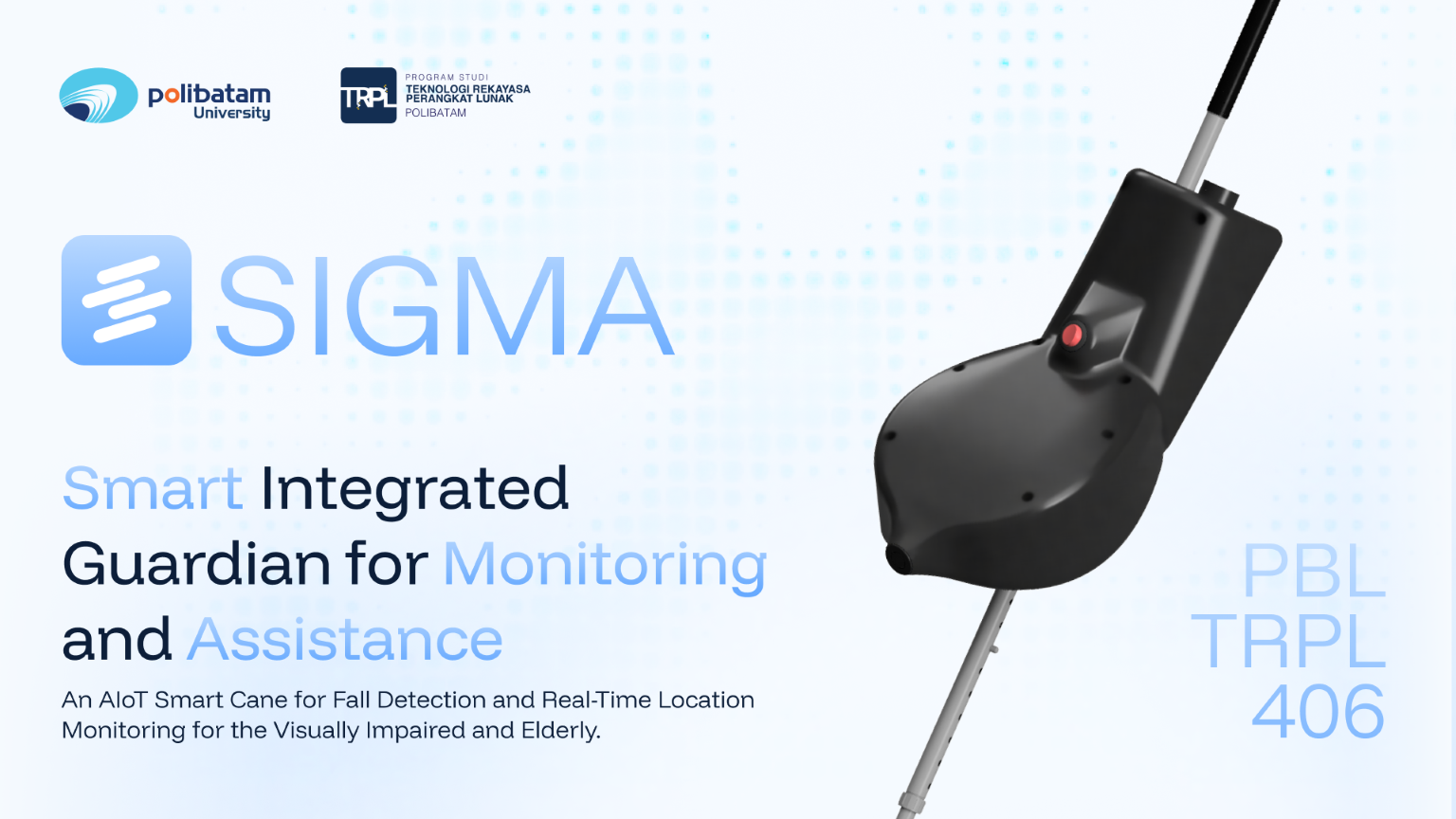
AI-based fall detection. An MPU6050 accelerometer and gyroscope capture the cane's motion. A TinyML Random Forest model runs on the microcontroller and classifies windows of sensor data to tell an actual fall apart from normal movement or the cane being bumped, which keeps false alarms low.
Real-time location tracking. A GPS Neo-6M module provides the user's position, which is sent to the backend over GSM. Guardians can follow the user's current location on a live map in the mobile app.
Obstacle detection. An ultrasonic sensor measures the distance to objects in front of the user. When an obstacle is within range, a buzzer gives immediate audible feedback so the user can change direction.
Panic button. A dedicated button on the handle lets the user send an emergency alert to their guardian at any time, without needing to find their phone.
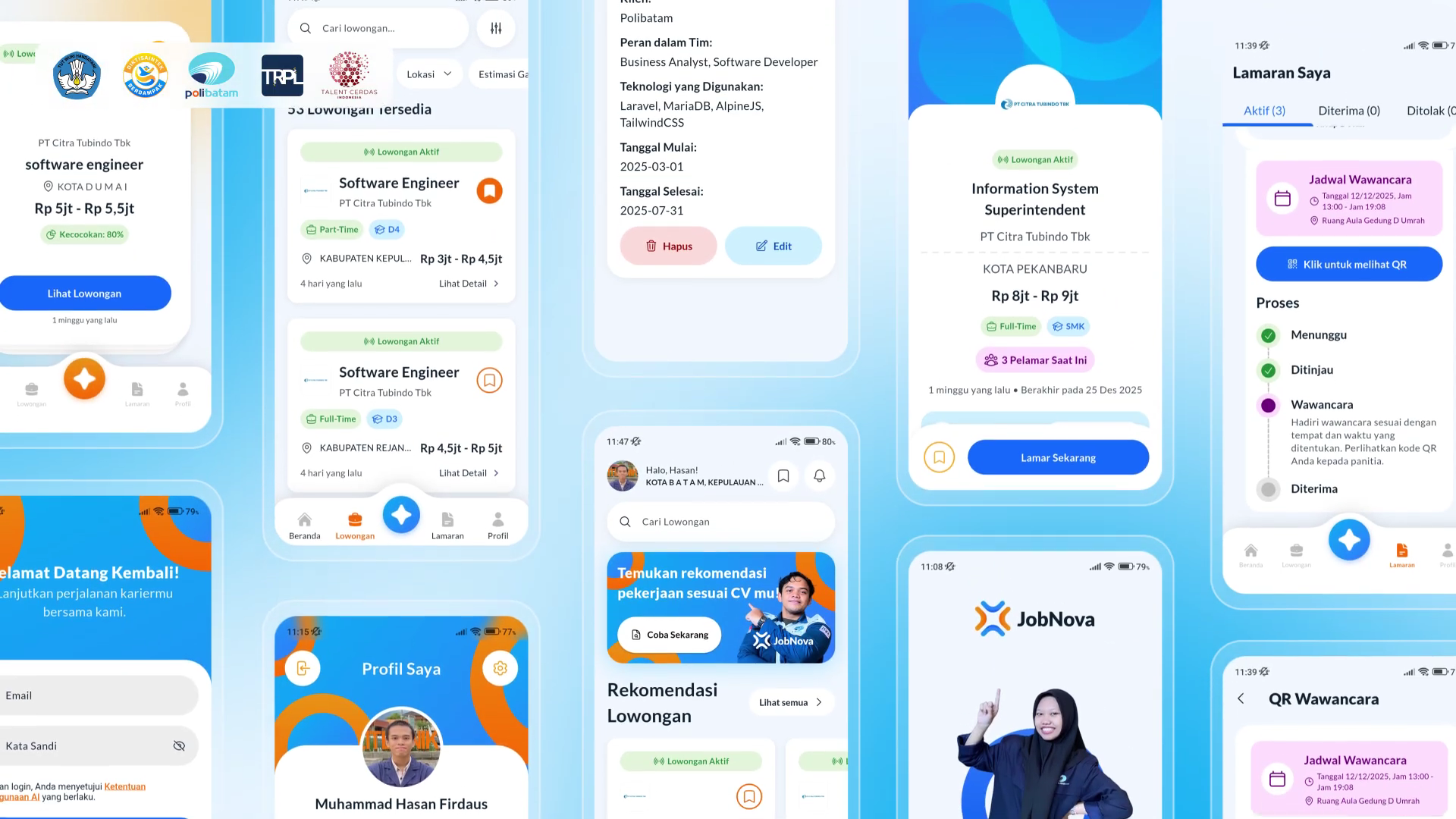
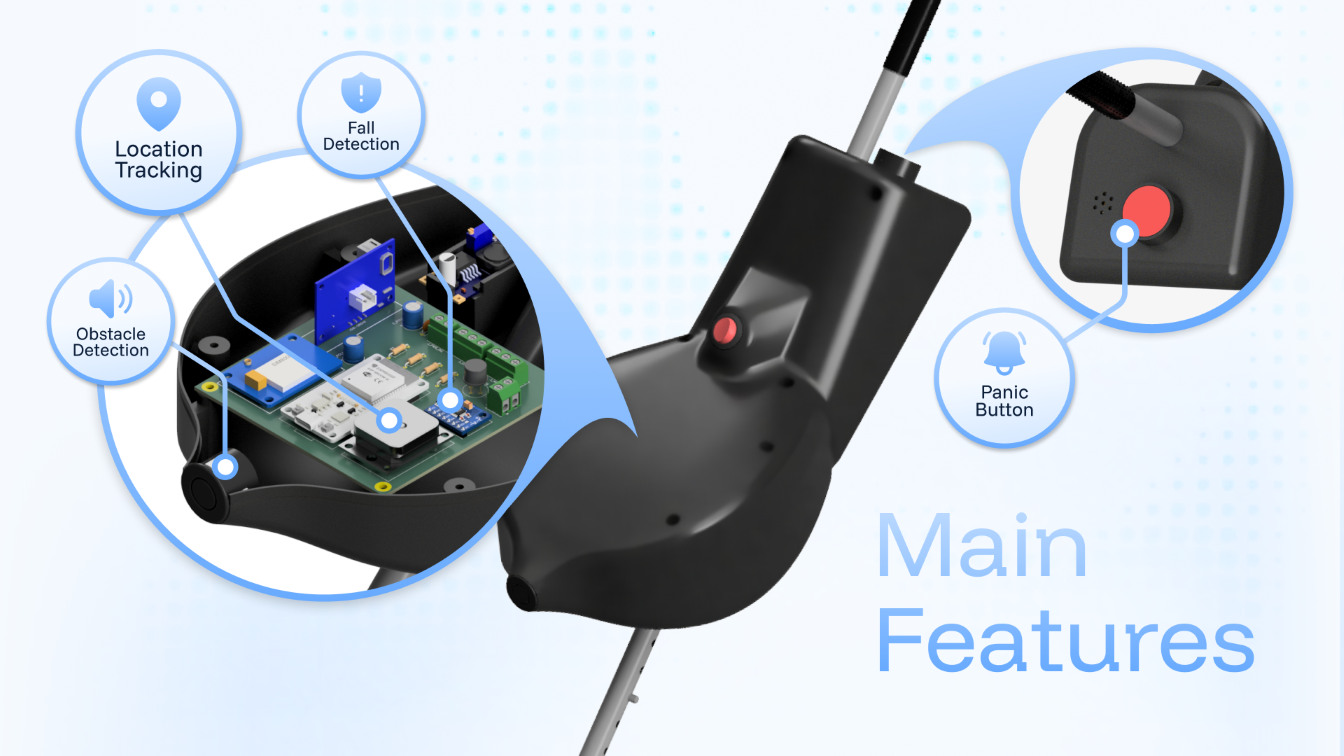
Guardian mobile app. Built with Flutter, the app shows the user's live location, sends emergency notifications through Firebase Cloud Messaging, and keeps a history of past incidents.
Admin dashboard. A web dashboard lets administrators manage registered devices and the guardians linked to them.
How It Works
The smart cane is built around an ESP32, programmed in C++ using PlatformIO. A custom PCB hub board integrates the MPU6050, GPS Neo-6M, SIM800L GSM module, ultrasonic sensor, buzzer, panic button, and battery into the cane's handle.
Motion data is processed on the device by the TinyML model, so a fall can be detected even before any network request is made. Location updates and incident events are published over MQTT to the Go backend, which stores the data and forwards emergency notifications to the guardian's app via Firebase Cloud Messaging. MQTT was chosen over a plain HTTP REST API because it uses less bandwidth and power, which matters on a 2G GSM connection.
Because fall detection, obstacle detection, GPS tracking, and network communication all need to run at the same time, the firmware is split into independent FreeRTOS tasks. This prevents one process, such as sending a location update, from blocking the others.
Development Approach
The team followed an Agile software development lifecycle with weekly sprints. Each sprint moved through planning, design, development, testing, deployment, and review, so requirements could be adjusted as the team learned more about embedded development. This was combined with functional hardware prototyping: designing the PCB, printing the cane's enclosure, assembling the electronics, and testing the device in the field.
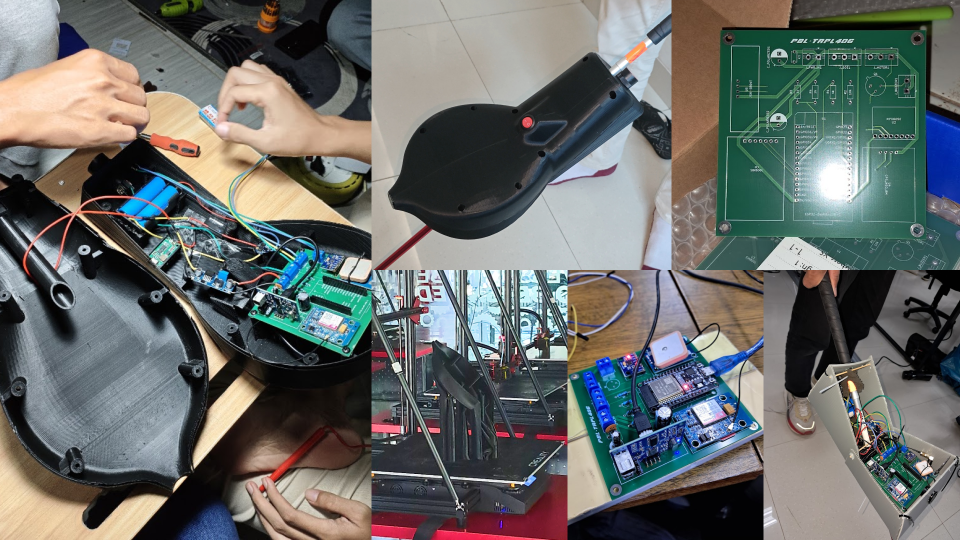
Some of the main challenges we ran into:
- Blocking firmware. Arduino-style code on the ESP32 runs sequentially by default. With multiple sensors and network processes, this caused features to wait on each other. We restructured the firmware around FreeRTOS tasks so each module runs independently.
- Power for the GSM module. The SIM800L can draw up to 2 A during transmission, which the ESP32's supply and the battery alone could not provide reliably. We added capacitors between the battery and the module to stabilize the power supply.
- No existing fall-detection dataset. There was no public dataset for falls detected through a cane, so we collected and labeled our own motion data and trained the Random Forest model ourselves.
Results
- A working smart cane prototype with an integrated PCB hub board and a 3D-printed enclosure.
- Fall detection, obstacle detection, location tracking, and the panic button all functioning on the device.
- A Flutter guardian app with live tracking, emergency notifications, and incident history, connected to the backend in real time.
- An admin dashboard for managing devices and guardians.
- The prototype demonstrates that combining IoT and AI can meaningfully improve safety and peace of mind for visually impaired and elderly users.
You can read the behind-the-scenes story of building the smart cane in this blog post.
Our Team
Project Manager
- 225362 - Kevin Riady, A.Md.Kom.
Team Member
- 4342401045 - Ziyadatul Khoir (Team Leader, AI/Machine Learning Engineer)
- 4342401035 - Muhammad Hasan Firdaus (System Architect, IoT/Hardware Engineer)
- 4342401037 - Hasna Fadhilah Ramadhan (Software Developer, Cloud Engineer)
- 4342401049 - Nanda Prasetyani (IoT/Hardware Engineer)
- 4342401051 - Rivana Alwarid (Business Analyst)
- 4342401057 - Muhammad Maulana Yusuf (UI/UX, Product Design Engineer)
 C++
 PlatformIO
 ESP32
 MQTT
 Go
 Flutter